


Updated November 23, 2026 · Reading time: 10 min · By the WaHallyu team, a Japanese and Korean fashion boutique in Paris
The Japanese men's jacket often surprises when you try it on: it doesn't hold the shoulders, it doesn't define the waist, and yet it structures the entire silhouette. It descends from very old garments, such as the haori, the hanten, or the Edo firemen's jacket, and from much more recent pieces, such as the military uniforms that Japanese designers love to rework. This guide tells you where it comes from, how to recognize it, and how to choose yours.
Key takeaways
- Three traditional jackets have bequeathed their codes to today's Japanese jacket: the haori, worn over the kimono, the hanten, an everyday padded jacket, and the Edo firemen's jacket.
- Sashiko, a reinforcing embroidery born in the Edo period, has become a material in its own right.
- Japanese designers also rework Western classics: balmacaan coat, military jacket, short jacket.
- A Japanese jacket is recognizable by its soft shoulder, its straight volume, and a material that holds without padding.
- Take the size based on the chest width and sleeve length in centimeters, never by the letter.
Traditional Japanese jackets
The Japanese wardrobe knew the jacket long before the arrival of Western clothing. Three pieces in particular have left their mark.
The haori. This is the jacket worn over the kimono. It resembles a shortened kimono, without crossed panels in the front, and closes with two small cords. In the Edo period, laws limited the luxury of outfits: merchants then got into the habit of wearing plain haori outside, with richly decorated linings [1]. The idea of a discreet jacket that hides a precious detail comes from there.
The hanten. This short winter jacket spread among common people in the 18th century. It is padded with layers of cotton to keep warm and is worn by both men and women [2]. It is the ancestor of all padded Japanese jackets.
The firemen's jacket. Edo firemen wore a reversible hanten, the hikeshi banten, made of several layers of cotton sewn tightly with the sashiko technique. One side bore the name of the brigade; the other, hand-dyed patterns, often heroes or creatures associated with courage or water [3]. Before intervening, these cotton jackets were watered to protect the firemen [4].

Sashiko: from reinforcement to signature
Sashiko is a running stitch embroidery, which appeared in the Edo period (1603 to 1867). It was first used to reinforce home-woven workwear and to assemble worn fabrics to make new ones. In the Meiji era, it becomes winter work in the countryside of northern Japan, when it is too cold to work outside [6].
This 19th-century jacket, preserved at the Metropolitan Museum of Art in New York, shows the result: indigo-dyed cotton, quilted and embroidered with white thread, with geometric patterns covering the entire surface.

Today, brands like Blue Blue Japan have made it a woven material: a "double-weave sashiko" that reproduces the texture of the embroidery in a dense and soft fabric. Blue Blue Japan, born in 1996 in the Daikanyama neighborhood in Tokyo, works with natural indigo and hand dyeing, for pieces designed to patina over time [8].
-
 Blue Blue Japan
Double weave sashiko oriental jacket - Indigo
€595,99
-
 Blue Blue Japan
Cloud Sea jacquard quilted jacket - Indigo
€499,99


When Japanese designers revisit the West
The other source of the modern Japanese jacket is Western classics, which Japanese designers study and redesign.
N.HOOLYWOOD is a good example. Its creator, Daisuke Obana, started as a vintage clothing buyer before founding his brand in 2001. It has been showing in New York since 2010 and even has an entire line dedicated to military clothing [9]. Three pieces from our selection show his method:
- The balmacaan coat. A loose coat with raglan sleeves and a small collar, which owes its name to an estate near Inverness, in Scotland. Its sleeve goes up to the collar to reduce seams and let less water through [10]. N.HOOLYWOOD offers it in a technical twill, with a removable hood.
- The short jacket. Inspired by the coach jacket, with a short collar and PrimaLoft insulation, a synthetic insulator developed for the American military in the 1980s [11].
- The short collarless coat. In gabardine wool, made in Japan: a very clean line that highlights what you wear underneath.
-
 N.HOOLYWOOD
Hooded balmacaan coat - Khaki
€669,99
-
 N.HOOLYWOOD
Short collar jacket - Khaki
€409,99
-
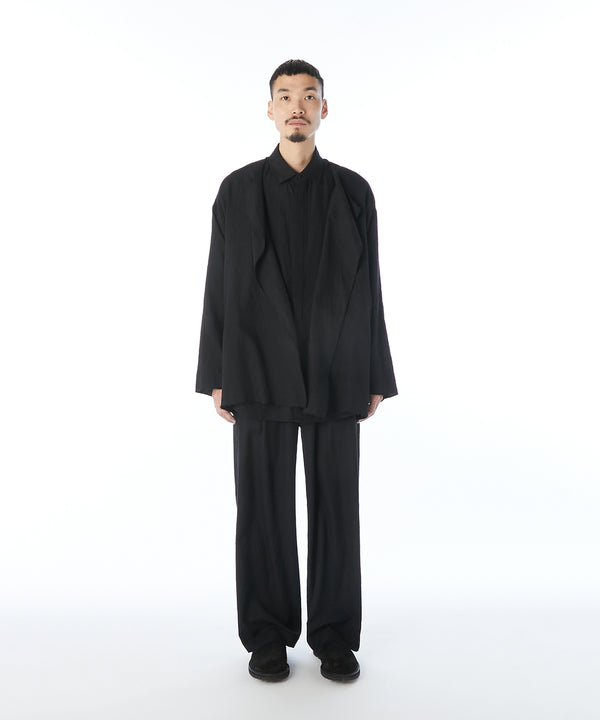 N.HOOLYWOOD
No collar short coat - Black
€429,99


How to recognize a Japanese jacket
Three details can be seen on a simple front photo:
- The shoulder is soft. No shoulder pads or rigid canvas: the fabric falls from the shoulder seam, often placed a little lower than on a classic jacket.
- The volume is straight. No marked waist or tapered back. The jacket falls from the body instead of tightening it.
- The material holds on its own. Since there is no internal structure, it is the fabric that gives the shape: dense sashiko, gabardine wool, technical twill.
Practical consequence: a Japanese jacket easily fits over thick knitwear or a loose shirt. It is a real outerwear layer, not a suit jacket.
Which jacket to choose?
| Your need | The jacket | Why |
|---|---|---|
| A piece of character for the mid-season | Oriental jacket in sashiko | Strong texture, indigo that patinas, worn like an overshirt |
| Cold and rain | Balmacaan coat | Long, loose, few exposed seams |
| An easy everyday jacket | Insulated short jacket | Warm without volume, balances wide pants |
| A dressed-up look | Short collarless wool coat | Clean line over a shirt or knitwear |
| The great cold | Down jacket or quilted jacket | Light insulation, easily layered |
The silhouette rule: a short jacket goes very well with wide pants; a long jacket requires a cleaner bottom. If you measure less than 1.75 m, prefer a jacket that stops at the hips.
-
 N.HOOLYWOOD
Puffer jacket - Charcoal
€679,99
-
 N.HOOLYWOOD
Quilted jacket - Khaki
€539,99
-
 Blue Blue Japan
Double cloth sashiko trousers - Black
€419,99


Choosing the right size
Japanese brands do not all use the same system. N.HOOLYWOOD sizes in JP 36, 38 and 40; Blue Blue Japan in S, M and L. In all cases:
- Measure a jacket you like flat, from armpit to armpit, and compare with the chest width on the sheet.
- Check the sleeve length: on a dropped shoulder, the sleeve starts lower, so the total length matters more than the shoulder.
- Think about what you will wear underneath: thick knitwear requires room.
On the manufacturing side, look at the sheet: the Blue Blue Japan oriental jacket and most of the N.HOOLYWOOD jackets in our selection are made in Japan; the N.HOOLYWOOD quilted jacket, inspired by a jacket from the American Air Force, is made in China.
Frequently asked questions
What is the traditional Japanese jacket called?
There are several: the haori, worn over the kimono, the hanten, short padded winter jacket, and the hikeshi banten, the reversible jacket of the Edo firemen [1] [2] [3].
What is sashiko?
A running stitch embroidery born in the Edo period to reinforce workwear. Today, the word also refers to fabrics that reproduce its texture [6].
Is a Japanese jacket worn closed?
It can be, but it is most often worn open, over a shirt, a t-shirt, or knitwear. Its straight cut is designed for that.
What is a balmacaan coat?
A loose coat with raglan sleeves and a small collar, whose name comes from an estate near Inverness, in Scotland [10].
What size to take?
Compare the chest width and sleeve length on the sheet with a jacket you already wear. In case of doubt about a loose fit, take the smallest size.
To go further: our guide to the Japanese men's shirt, our overshirt guide, the N.HOOLYWOOD and Blue Blue Japan pages.
Sources
- « Haori », Wikipedia (English), accessed November 23, 2026. en.wikipedia.org
- « Hanten », Wikipedia (English), accessed November 23, 2026. en.wikipedia.org
- « Hikeshi banten », Wikipedia (English), accessed November 23, 2026. en.wikipedia.org
- « Hikeshi », Wikipedia (English), accessed November 23, 2026. en.wikipedia.org
- « Fireman's jacket », Japan, 19th century, The Metropolitan Museum of Art, No. 1983.100, public domain. metmuseum.org
- « Sashiko », Wikipedia (English), accessed November 23, 2026. en.wikipedia.org
- « Sashiko Jacket », Japan, second half of the 19th century, The Metropolitan Museum of Art, Seymour Fund, 1967, No. 67.172.1, public domain. metmuseum.org
- « About Us », presentation of Blue Blue Japan, official Seilin & Co. website. seilin.net
- « About », official N.HOOLYWOOD website. n-hoolywood.com
- « Balmacaan », Wikipedia (English), accessed November 23, 2026. en.wikipedia.org
- « PrimaLoft », Wikipedia (English), accessed November 23, 2026. en.wikipedia.org
Product photos: WaHallyu and the brands presented. Museum images: credits and licenses indicated under each image.


