The essentials
- Unisex jeans are not men's jeans sold to women: they feature a high-waisted straight cut without pronounced shaping, designed to fit both body types.
- Japanese denim dominates this category thanks to its dense weaves and indigo dyes that develop a unique patina over time.
- When choosing your size, rely on your waist measurement in centimeters, never on generic sizes.
- Expect to pay between 70 and 600 euros for a Japanese or Korean brand piece shipped from Paris.
Unisex jeans have moved from the "novelty" section to serious wardrobes, and Japan has had a lot to do with it: for decades, its spinning mills have produced denim that is denser and more interesting than mass-produced fabrics. This guide explains what makes a cut truly unisex, why Japanese denim changes the experience, and how to choose your size without making a mistake.
What makes jeans truly unisex?
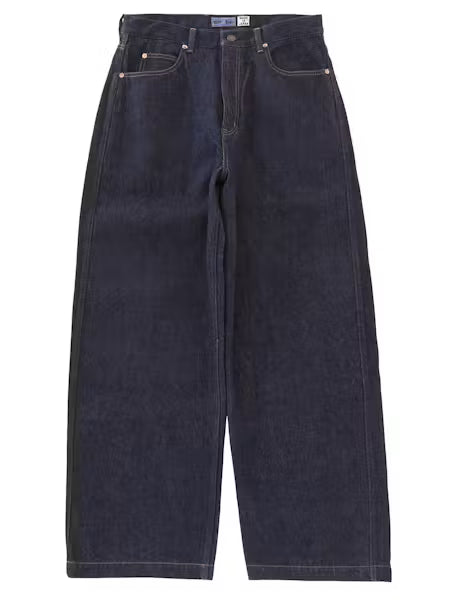
Unisex jeans are based on three precise pattern-making choices: a straight or slightly loose cut, a high waist, and no pronounced shaping at the hips. These three elements allow the garment to fit correctly on different body types.
This is the opposite of the usual denim logic, where women's cuts cinch the waist and widen the hips, while men's cuts remain straight from the waist to the thigh. A true unisex jean adopts an intermediate construction, often inherited from workwear, where comfort took precedence over shaping. Many brands claim "unisex" to sell a men's model to everyone: check the technical sheet, not the label.
Why is Japanese denim different?
Japanese denim stands out for the density of its weave and its dyeing methods. Japanese spinning mills have retained narrow, slower looms that produce an irregular and lively fabric, unlike industrial production, which creates perfectly uniform cloth.
Then there is aizome dyeing with natural indigo, which penetrates the fiber differently: the jeans start dark and then fade according to your own movements. After a year, two people wearing the same model will have two visually different pieces. This is what explains connoisseurs' attachment to these denims, and it is also what justifies the price difference compared to fast fashion jeans.
Korean jeans or Japanese jeans: what's the difference?
Korean jeans and Japanese jeans aim for different effects. Japanese denim focuses on the material: dense fabric, deep indigo, a patina that develops over time, and an unapologetic workwear spirit. Korean denim focuses on the silhouette: very wide or sharply straight cuts, uniform and light washes, and a minimalist urban look.
In practice, choose Japanese if you want a piece that ages and becomes personalized, and Korean if you are looking for a contemporary cut that is immediately wearable. The two overlap in the world of unisex jeans, because both wardrobes have long accepted loose, genderless cuts. Our Korean style details this logic of proportions.
How to choose your size for unisex jeans?
The size of unisex jeans is chosen by waist measurement in centimeters, never by generic size. This is the only reliable measure when the same model is sold to different body types.
The three-step method:
- Measure your waist where you actually wear the trousers, not at the natural waist.
- Compare it to the model's size guide, in centimeters. If the seller only gives S/M/L without measurements, be wary.
- For a loose cut, do not size down: the volume is part of the design. If you are between two, take the one that corresponds to your exact measurement.
One last point that few stores mention: raw, unwashed denim stretches by two to three centimeters at the waist after a few weeks of wear. If your model is raw, a slightly snug fit at the start will become perfect. On already washed denim, what you try on is what you will keep.
Are unisex jeans suitable for all body types?
Unisex jeans suit most body types, with one nuance: the greater the difference between your waist measurement and your hip measurement, the more a straight cut without shaping will require adjustment. In this case, there are two simple solutions: choose the size that fits the hips and have the waistband taken in by a tailor, or opt for a very wide cut that does not accentuate any area.
For straight silhouettes, both men and women, unisex jeans are often more flattering than gendered cuts: they do not try to create shaping that isn't there and let the proportions speak for themselves. They are also the most durable garment in this category, as they do not depend on any seasonal cut trends.
Caring for Japanese denim
Japanese denim is cared for by washing it as little as possible, inside out, in cold water, without fabric softener. Each wash removes indigo: spacing out washes allows the patina to develop where you actually wear it.
Regular wearers wait several months before the first wash of raw denim, but nothing forces you to. Air out the jeans between wears, treat stains locally, and wash when necessary. Always air dry: the dryer breaks the fiber and sets creases in the wrong places.
Our selection of jeans, shipped from Paris
At Wahallyu, our women's jeans and men's jeans sections bring together Japanese and Korean denims from recognizable brands, including Blue Blue Japan for natural indigo. Each product page specifies the composition and brand, and prices range from 70 to 600 euros.
Wahallyu was born from a trip to Japan and Korea, from the discovery of labels attached to materials and traditional know-how. Everything leaves Paris in 2 to 5 business days for mainland France. Unsure about a size? Send us your waist measurement, and we will guide you precisely.