The essentials
- Unisex clothing is not men's clothing sold to everyone: it uses a neutral pattern, without shaping or darts, designed to fit two body types.
- Japanese and Korean wardrobes are naturally unisex: their loose cuts and structured volumes are not gender-dependent.
- When choosing a size, rely on measurements in centimeters, never on S, M, L labels, which vary from brand to brand.
- Expect to pay between 70 and 600 euros for a designer piece, shipped from Paris in 2 to 5 days.
For a long time, unisex clothing was a catch-all category: loose t-shirts and shapeless sweatshirts sold as unisex because they were designed for no one. Japanese and Korean wardrobes have taken a different approach, which is what makes their pieces truly wearable by everyone. This guide explains what distinguishes a truly unisex cut, which pieces work, and how to choose your size.
What makes a truly unisex garment?
Unisex clothing is based on a neutral pattern: a straight or loose cut, no pronounced shaping at the waist, soft rather than structured shoulders, and lengths designed to fall correctly on different body types.
This is the opposite of the usual Western approach, where women's clothing cinches the waist and widens the hips, while men's clothing remains straight from the chest to the hip. A truly unisex garment uses an intermediate construction, often inherited from workwear or traditional clothing, where comfort took precedence over shape.
The test is simple: check the product details. If the seller lists the item as "unisex" but only provides a men's size guide, you are buying men's clothing with a marketing label.
Japanese and Korean wardrobes, unisex by design
Japanese and Korean wardrobes are unisex by design because their historical references already were. The kimono and its derivatives are worn wrapped, without defining the waist or following the curves: the silhouette is created by the fabric and the belt, not the pattern.
This heritage is reflected in contemporary cuts: wide legs, dropped shoulders, straight jackets, and loose shirts. A piece designed according to these principles works on both male and female bodies without the need to create two patterns. This is why our unisex section is not a compromise but a category in its own right.
Which pieces work as unisex clothing?
Not all pieces lend themselves to unisex clothing. Here are the ones that work, and why:
| Item | Why it works | What to look out for |
|---|---|---|
| Loose shirt | Soft shoulders, straight chest, no darts | Length: mid-bum length suits most people |
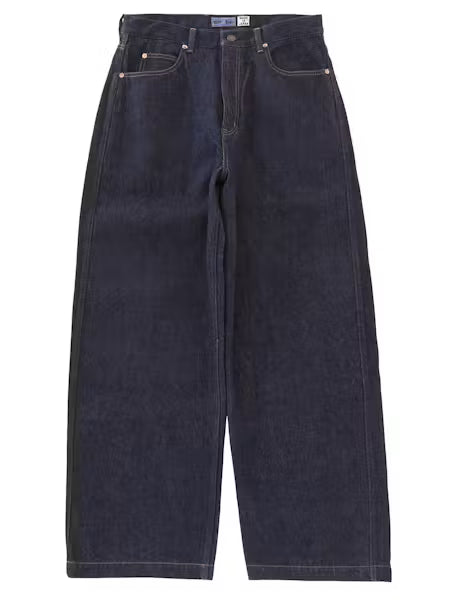
| Straight jeans | High waist, straight leg, no shaping | Waist circumference, never the generic size |
| Pleated trousers | Pleats accommodate different body types | The hem can be altered if necessary |
| Unlined jacket | Lightweight structure, falls well on all shoulders | Back width |
| Crew-neck knit | The most neutral piece in the wardrobe | Nothing in particular |
Conversely, be wary of highly structured jackets and tapered trousers sold as unisex: these cuts are based on gendered patterns and fit poorly on half the people.
How to choose your size for a unisex garment?
The size of a unisex garment should be chosen based on measurements in centimeters, never on the label. A Japanese M, a Korean M, and a European M have no relation to each other, and loose cuts make it even harder to judge.
The three-step method:
- Measure yourself: chest circumference and shoulder width for tops, waist circumference and inseam length for bottoms.
- Compare with the model's guide, not your usual size. On an oversized cut, the difference can be up to two sizes.
- If you are unsure about an already loose cut, choose the smaller size: the volume is part of the design and does not need to be doubled.
A useful tip if you are used to women's sizing: for a straight-cut unisex garment, start with your chest measurement rather than your dress size. The two almost never correspond.
How to wear unisex clothing without being overwhelmed by it?
Unisex clothing is worn by creating a single anchor point in the outfit: a defined waist, a tucked-in top, rolled-up sleeves, or a jacket draped over the shoulders. This is the rule that prevents the "borrowed clothing" effect.
Three combinations that work regardless of body type:
- Loose shirt tucked into high-waisted trousers, sleeves rolled up.
- Fine knit under a straight jacket, with wide jeans.
- Monochrome outfit (matching top and bottom), the most Seoul-inspired and easiest look to achieve.
The neutral colors of the Japanese and Korean wardrobes (ecru, navy, black, indigo, beige) can be combined without risk, making it even easier.
Which brands make truly unisex clothing?
The brands that succeed with unisex clothing are those that did not have to try: their cuts were already neutral. Blue Blue Japan is a prime example, with its indigo pieces inherited from Japanese workwear and designed for movement rather than silhouette. Dunst, a Korean label, works in the same spirit with contemporary volumes and a sober color palette.
Denim is where this logic is best seen: we explain why in our unisex jeans guide, which explains how Japanese weaving and dyeing transform a piece that everyone thinks they know.
Our unisex section, shipped from Paris
At Wahallyu, the unisex section brings together pieces whose cuts truly work on both body types: shirts, jeans, trousers, knits, and coats from recognizable Japanese and Korean brands, with the fabric and measurements specified on each product page.
Wahallyu was born from a trip to Japan and Korea, from the discovery of labels focused on fabrics and craftsmanship rather than marketing categories. Prices range from 70 to 600 euros, everything ships from Paris in 2 to 5 business days to mainland France, and if you are unsure about a size, send us your measurements: we will give you a precise answer.