The Essentials
- Korean men's trousers are defined by three things: a high waist, a wide leg that falls straight from the hip, and a hem that stops cleanly at the shoe without breaking.
- Three cuts cover the entire wardrobe: wide-leg pleated chinos, curved-leg wool trousers, and drawstring work trousers.
- Sizing is based on your actual waist circumference, never your usual jeans size. Korean brands use three different sizing systems, sometimes on the same page.
- Expect to pay 130 to 300 euros for branded Korean trousers, shipped from Paris in 2 to 5 business days.
Korean men's trousers are the piece that changes a silhouette the most, and they are also the item most likely to result in an unsuccessful online purchase. Not because of the cut, which is generally flattering, but because of the sizing: three measurement systems coexist among Korean brands, and no one explains them. This guide covers the cuts, materials, and methods that help you avoid returns.
What defines Korean men's trousers?
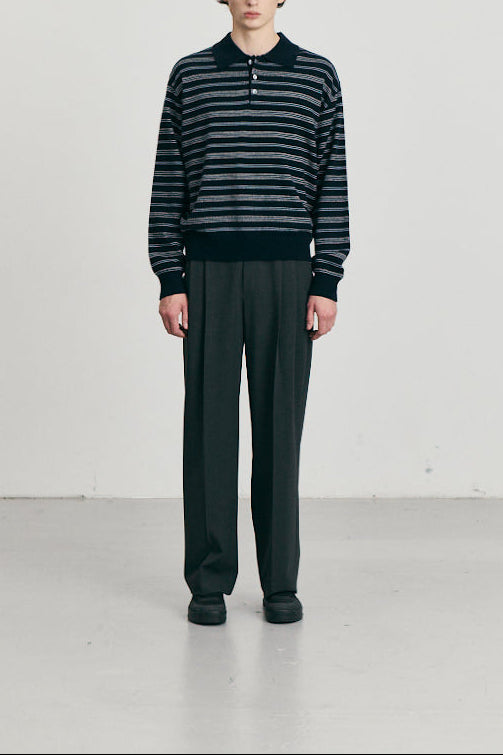
Korean men's trousers are defined by a high waist, a wide leg that falls straight from the hip, and a clean-stopping length. The three go together, and it is their combination that creates the silhouette.
The waist is worn at the navel or just below, never on the hips. This adjustment alone visually elongates the leg by several centimeters, which is why the Korean silhouette appears more slender than the equivalent European cut.
The leg falls straight from the hip, without narrowing at the knee or flaring at the bottom. The volume is consistent throughout the length, which requires a fabric that holds its shape: wide trousers in a fabric that is too soft will float instead of falling.
Finally, the length follows a precise rule. The hem rests on top of the shoe and stops there. No break, no fabric pooling at the foot. Korean trousers that are too long immediately lose the desired effect.
What are the three cuts of Korean trousers?
Three cuts cover the entire Korean men's wardrobe, and each serves a different purpose.
| Cut | What it offers | What to look out for |
|---|---|---|
| Wide-leg pleated chinos | versatility, from the office to the weekend | the number of pleats, which changes the volume at the hips |
| Curved-leg wool trousers | the most polished line, a clean fall | the length, which needs to be adjusted to the centimeter |
| Drawstring work trousers | comfort, with an elasticated or tied waist | the fabric weight, which determines the fall |
The wide-leg pleated chinos are the simplest entry point. One or two pleats open up the volume at the hips and let it fall straight. Two pleats provide more room in the upper thigh, which suits broader body types; a single pleat remains more understated.
The curved-leg wool trousers are the most carefully constructed piece. The side seam follows a slight curve rather than a straight line, which contours the leg without constricting it. It is a tailoring detail invisible in photos, yet it is what makes all the difference when worn.
The drawstring work trousers come from utilitarian clothing. Elasticated or tie-fastened waist, deep pockets, dense fabric. They are the most comfortable and easiest cut to wear, provided the fabric weight is sufficient.
Does the Korean wardrobe have traditional trousers?
Yes, they are called baji, and they are the trousers worn under the hanbok, the traditional Korean outfit. Two of their characteristics are found directly in contemporary cuts.
The first is the generous room in the thigh, which was not an aesthetic choice but a necessity: people sat on the floor with their legs crossed, and the garment had to allow for it. The second is the very high waist, tied with a sash rather than held by a belt.
The baji was tapered at the ankle, which modern cuts have abandoned. But the original idea—a wide volume at the top that falls in a straight line—has remained intact. That is what you are buying today.
How do you choose the right size for Korean men's trousers?
Sizing is based on your actual waist circumference, measured where the trousers will sit, that is at the navel and not on the hips. This is the first mistake, and the most costly: your usual jeans size means nothing here, because jeans are worn low.
The second difficulty is unique to Korean brands, and it is striking. On our men's trousers page alone, three sizing systems coexist:
| Brand | System used | Sizes offered |
|---|---|---|
| Dunst | letters | S, M, L |
| Blue Blue Japan | letters | S, M, L |
| LE17SEPTEMBRE | European men's numbering | 46, 48, 50 |
A customer who has spotted a LE17SEPTEMBRE trousers in 48 and a Dunst chino right next to it has no way of knowing which of the three letters corresponds to them. Here is the chart we use:
| Men's numbering | 44 | 46 | 48 | 50 | 52 |
|---|---|---|---|---|---|
| Letters | XS | S | M | L | XL |
Be careful not to confuse this with women's numbering, where 36 equals S. Both scales use numbers and do not refer to the same thing at all. A brand that sells to both audiences may display 36 on a women's piece and 46 on a men's piece for the same letter.
The method that works involves three steps. Measure your waist circumference at the navel without tightening. Then take a pair of trousers you already wear that fits you, lay it flat, and measure the waistband from one end to the other, then multiply by two. Finally, compare it to the product page, checking whether the published measurement is given flat or as a full circumference: both conventions coexist among the same brands, and the difference can be twofold.
What material should you choose for Korean men's trousers?
The material determines the fall, and on a wide leg, the fall accounts for more than half of the result.
- Tight-weave cotton: the chino category. Sturdy enough for the leg to remain straight, flexible enough for everyday wear. The safest choice for a first piece.
- Cool-touch wool or wool blends: the cleanest fall, which makes the trousers look more polished than they are. Suitable all year round in a lightweight version.
- Thick sweatshirt fabric: comfort, provided the fabric weight is high enough. Below 300 grams per square meter, wide sweatshirt trousers will sag.
- Raw denim: holds volume very well, but fades and bags at the knees. Choose this if you like the piece to evolve.
The key indicator: on a wide leg, fabric that is too light does not fall; it floats. Check the fabric weight before the color, and be wary of wide trousers advertised as lightweight.
Korean trousers or Japanese trousers: what's the difference?
Korean trousers are worn very high with a straight, clean leg, whereas Japanese trousers sit lower on the waist with a deeper crotch and softer volume. The difference is noticeable on the first try-on.
| Criterion | Korean trousers | Japanese trousers |
|---|---|---|
| Waist height | very high, at the navel | mid to high |
| Crotch | standard | deep, sometimes dropped |
| Leg | straight, consistent volume | tapered or very wide depending on the style |
| Hem | clean, without breaking | often tapered or rolled |
Both work, and neither is superior to the other. Korean trousers create a line, Japanese trousers create volume. Our guide to Korean clothing details the logic of proportions that applies to the entire wardrobe.
What to wear with Korean men's trousers?
The rule that governs everything: one volume at a time. Wide trousers call for a fitted top, either short or tucked in. Two layered volumes break up the silhouette you have just created.
The safest combination remains wide trousers with a tucked-in shirt or fine knitwear. If you add a jacket, wear it open: the two panels create vertical lines that extend the line of the trousers.
For footwear, prefer a thin sole and a rather rounded toe. Chunky shoes under a wide leg squash the overall look, while a slim silhouette on the ground allows the hem to fall cleanly.
Our guide to Korean men's style details the five basic pieces and how to wear them together over a week.
Our trousers selection, shipped from Paris
At WaHallyu, our men's trousers section brings together identifiable Korean and Japanese labels, arranged by cut, with the material and measurements specified on each product page, size by size and in centimeters.
WaHallyu was born from a trip to Japan and Korea, and the discovery of houses whose expertise lies in construction rather than the logo. Prices range from 130 to 300 euros for trousers, and everything ships from Paris in 2 to 5 business days to mainland France.
Unsure about the size? Send us your waist circumference measured at the navel and the flat measurement of a pair of trousers that already fits you. We measure the piece before shipping. To put together the rest of the outfit, our men's clothing section is organized by category.