Updated November 23, 2026 · Reading time: 11 min · By the WaHallyu team, a Japanese and Korean fashion boutique in Paris
Women's Korean fashion has many faces, from colorful streetwear to very minimalist silhouettes. The one we love at WaHallyu is the latter: carefully crafted cuts, comfortable volumes, fabrics that drape beautifully, and a detail that makes all the difference. This guide explores the origins of this aesthetic, introduces the Seoul brands that champion it, and helps you build a wardrobe with five staple pieces.
Key takeaways
- Traditional Korean clothing, the hanbok, consists of a top (jeogori), trousers or a skirt, and a coat. Its form has varied greatly over the centuries.
- The term "hallyu," the Korean wave, first appeared in the Chinese press in 1999. Seoul has been hosting its own fashion week since 2000.
- Seoul designer brands focus on cut and fabric rather than logos: Low Classic, LE17SEPTEMBRE, The Loom Atelier, Dunst.
- Five pieces are enough to get started: a shirt, wide-leg trousers, a skirt, a knit piece, and a jacket or coat.
- The key to a successful silhouette: play with lengths and volumes, considering the outfit as a whole.
From the hanbok to modern fashion
The hanbok, traditional Korean clothing, is based on four elements: the jeogori (a crossed top), the baji (trousers), the chima (a skirt), and the po (a coat). This basic structure has remained the same for centuries, but the length, width, and shape of each piece have changed considerably over time. Today, Koreans mainly wear it for special occasions: weddings, holidays, and ceremonies. Since 1996, the South Korean Ministry of Culture has even organized a hanbok day to encourage people to wear it [1].
In this 19th-century painting, we see women wearing hanbok: a short, fitted jeogori and a long, full chima. A short top over a voluminous bottom: the play of proportions that gives many modern Korean silhouettes their charm was already there.

Seoul, fashion capital
The global popularity of Korean culture has a name: hallyu, or the Korean wave. The term first appeared on November 19, 1999, in the Chinese newspaper Beijing Youth Daily, to describe the Chinese public's enthusiasm for Korean dramas and music [3]. Dramas, K-pop, and K-beauty subsequently brought fashion along with them.
Seoul has provided itself with the means to become a capital. Its fashion week, Seoul Fashion Week, dates back to the first "Seoul Collection," organized in October 2000. Since 2014, it has been held at the Dongdaemun Design Plaza, the building designed by architect Zaha Hadid. In 2025, it also expanded to the fashion districts of Seongsu, Hannam, Sinsa, and Cheongdam [4].
The Dongdaemun district, meanwhile, has been the commercial heart of Korean fashion for over a century: its market opened in 1905, and today it brings together around 30,000 specialized boutiques and 50,000 manufacturers [5]. This proximity between designers, workshops, and fabrics partly explains the speed and precision of Korean fashion.
Women's designer brands to know
The Seoul brands we have selected have one thing in common: the value lies in the cut and the fabric, not the logo.
- Low Classic. Founded in Seoul in 2009 by Lee Myungshin, Hwang Hyng-ji, and Park Jin-seon, who met while studying in the costume department at Konkuk University [6]. The brand describes itself as a "timeless design" wardrobe, with simple yet highly structured silhouettes [7].
- LE17SEPTEMBRE. Launched in Seoul in 2013, the brand offers pieces with structured silhouettes, featuring unexpected details, designed and made in Korea [8].
- The Loom Atelier. A high-end women's ready-to-wear brand founded in South Korea in 2010 by Jung Wonkyung, known for its understated tailoring and commitment to craftsmanship [9].
- Dunst. A contemporary brand from the Korean group LF, distributed by more than 100 retailers in around thirty countries. It presented its first show at Seoul Fashion Week in September 2026 and has a flagship store in the Seongsu district [10].
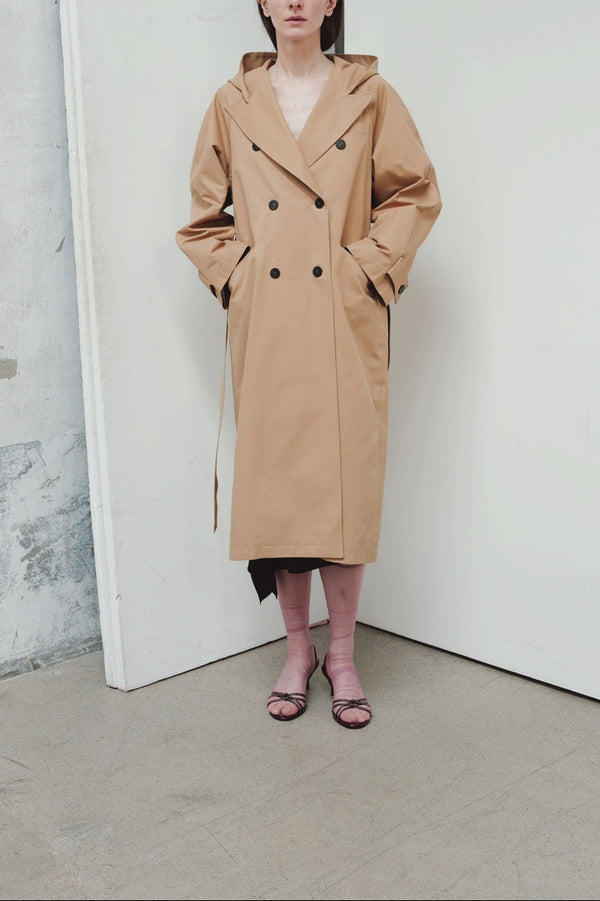
-
 Low Classic
Trench coat - Khaki brown
€369,99
-
 LE17SEPTEMBRE
Mila wool scarf wrap jacket - Ivory
€338,99


The five staple pieces
These five pieces form a foundation that can be adapted to your daily life. Do you rarely wear skirts? Replace it with jeans. Do you already have a coat you love? Keep it and start with a top or trousers.
| Piece | Its role | What to check |
|---|---|---|
| Straight or loose shirt | Can be worn on its own, tucked in, or open over a top | Length, ease at the chest, fabric structure |
| Wide-leg trousers | Adds movement and defines the volume of the lower half | Waist circumference, ease at the hips, leg length |
| Short or midi skirt | An alternative to trousers for varying proportions | Comfort when walking and sitting |
| Knit piece | Adds texture and makes layering easier | Feel, thickness under a jacket, care |
| Jacket or coat | Gives shape to the entire outfit | Length, shoulder, ease with an underlayer |
The shirt
The most versatile piece. Tuck only the front to show the waist, wear it fully tucked in for a dressier look, or open over a tank top. Fine stripes and structured cotton are safe choices.
-
 Dunst
Blue striped cotton shirt
€104,99
-
 The Loom Atelier
Khaki Tucked Line shirt
€249,99
-
 Dunst
Ivory striped cotton shirt
€104,99


Wide-leg trousers
The best starting point for exploring volume. When trying them on, look at the folds at the hips and check that the hem does not drag with your usual shoes. Darts and curved lines are typical of Seoul brands.
-
 Low Classic
Wide-leg curved cotton trousers - Khaki
€229,99
-
 LE17SEPTEMBRE
Curved wool trousers - Black
€299,99
-
 Dunst
Wide double pleated chino trousers, beige
€119,99


The skirt and knit piece
A mini skirt with a loose knit piece does not have the same effect as a midi skirt with a flowing shirt. Choose the length according to the desired look and your comfort. The knit piece, meanwhile, adds contrast to smoother fabrics: a short cardigan can be worn under a coat or on its own, buttoned up.
-
 Dunst
Black wool-blend mini skirt
€109,99
-
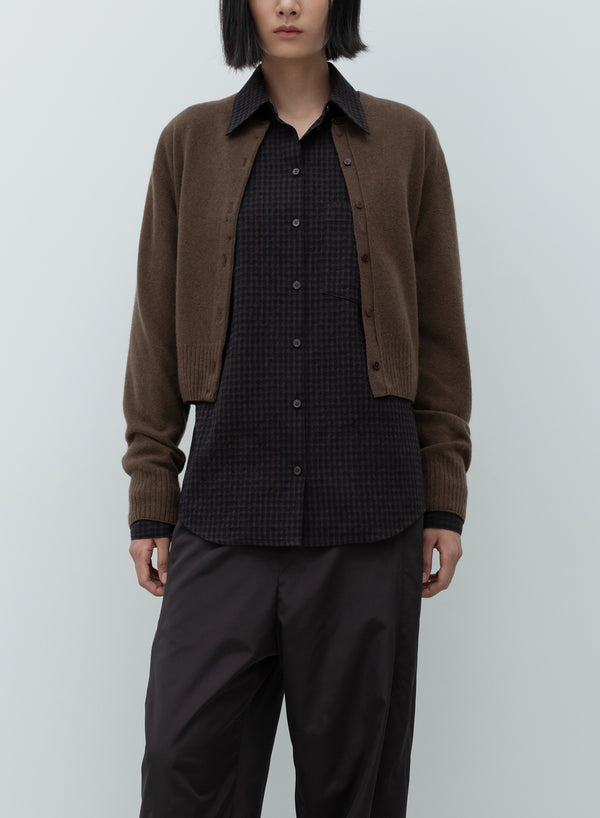 Low Classic
Cropped wool cardigan - Brown
€199,99
-
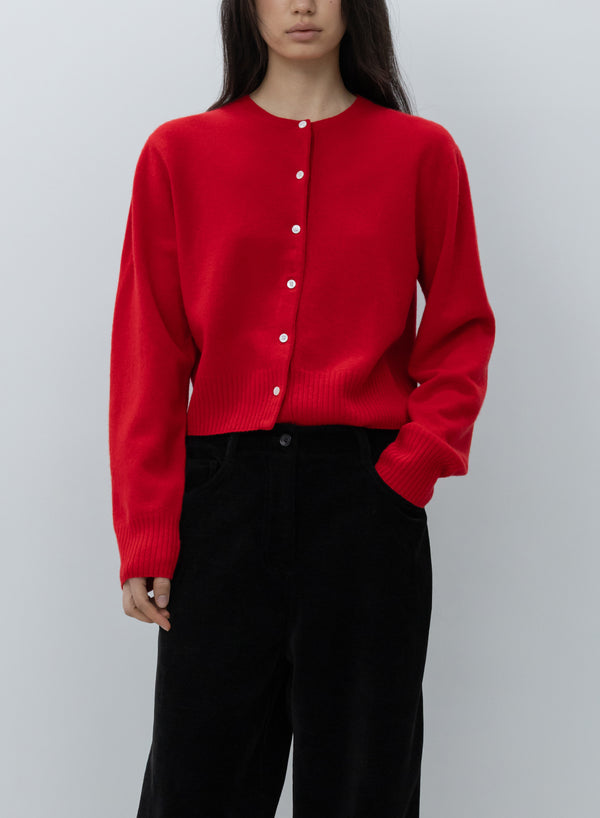 Low Classic
Cropped wool cardigan - Red
€199,99

The jacket or coat
It finishes the silhouette. Wear it open to show the layers, closed to highlight its cut, or belted if the style allows. Always try both ways before choosing.
-
 Dunst
Women's grey double-breasted coat, wool & cashmere
€339,99
-
 The Loom Atelier
Brown scarf-neck volume jacket
€599,99
-
 Low Classic
High-neck reversible shearling-effect jacket - Beige
€449,99


How to put together a silhouette
Start with a piece that makes you want to get dressed, then build around it. Three simple combinations:
| Occasion | The outfit | The detail that makes all the difference |
|---|---|---|
| Everyday | Striped shirt, beige wide-leg trousers, slim sneakers | The shirt tucked in only at the front |
| At the office | Buttoned short cardigan, black wool trousers, double-breasted coat | The short cardigan defining the waist over loose trousers |
| On the weekend | Knit piece, mini skirt, long trench coat | The contrast between a short skirt and a long coat |
A loose top can perfectly complement loose trousers: in this case, choose fabrics that drape well and a top length that shows the waist or hips. In terms of colors, beige, ecru, khaki, gray, and black pair well together; a single brighter color, such as a red cardigan, is enough to add character.
Buying well: fabric, size, label
The fabric. Two pairs of trousers of the same width can create very different silhouettes depending on the fabric: structured cotton adds definition, while soft wool follows the movement. In the European Union, the fiber composition must be indicated before purchase, including online [11].
The size. Korean brands often have their own sizing standards. Rely on the measurements in centimeters on each product page (waist circumference, length, chest width) rather than the letter.
The origin. The LE17SEPTEMBRE pieces in our selection are made in South Korea, as indicated on each product page.
Frequently asked questions
What defines women's Korean fashion?
There are several styles. The style of Seoul designer brands is based on cut, volume, and the quality of fabrics, rather than logos or prints.
Which women's Korean fashion brands should I know?
Among the Seoul designer brands: Low Classic, founded in 2009, LE17SEPTEMBRE, launched in 2013, The Loom Atelier, founded in 2010, and Dunst [6] [8] [9] [10].
What is the hanbok?
Traditional Korean clothing, consisting of a crossed top (jeogori), trousers (baji) or a skirt (chima), and a coat (po) [1].
When does Seoul Fashion Week take place?
Twice a year, for the spring-summer and autumn-winter seasons. The main venue is the Dongdaemun Design Plaza [4].
Does Korean fashion suit all body types?
Yes, provided you choose where to place the volume. A short jacket elongates the leg with wide-leg trousers; a long, straight coat structures a rounder silhouette. Rely on the measurements in centimeters.
To learn more: our guide to Korean clothing, our guide to women's Korean jackets, and our full selection of women's Korean clothing.
Sources
- "Hanbok," Wikipedia (English), accessed November 23, 2026. en.wikipedia.org
- "Genre Paintings," Korea, 19th century, album of four sheets, The Metropolitan Museum of Art, no. 2026.343a–d, public domain. metmuseum.org
- "Korean Wave," Wikipedia (English), accessed November 23, 2026. en.wikipedia.org
- "Seoul Fashion Week," Wikipedia (English), accessed November 23, 2026. en.wikipedia.org
- "Dongdaemun Market," Wikipedia (English), accessed November 23, 2026. en.wikipedia.org
- "High notes: Low Classic reaches new heights at Seoul Fashion Week," Wallpaper. wallpaper.com
- Low Classic official website. lowclassic.com
- "About," LE17SEPTEMBRE official website. le17septembre.com
- "The Art of Quiet Dressing: The Loom Atelier," Fabric of Society, July 20, 2026. fabricofsociety.luxury
- "Dunst names NMIXX's Sullyoon as global ambassador," The Herald Business, October 23, 2026. biz.heraldcorp.com
- Regulation (EC) No 1007/2011 on textile fibre names and labelling, Articles 7 and 16, EUR-Lex. eur-lex.europa.eu
Product photos: WaHallyu and the brands presented. Museum images: credits and licenses indicated under each image.